
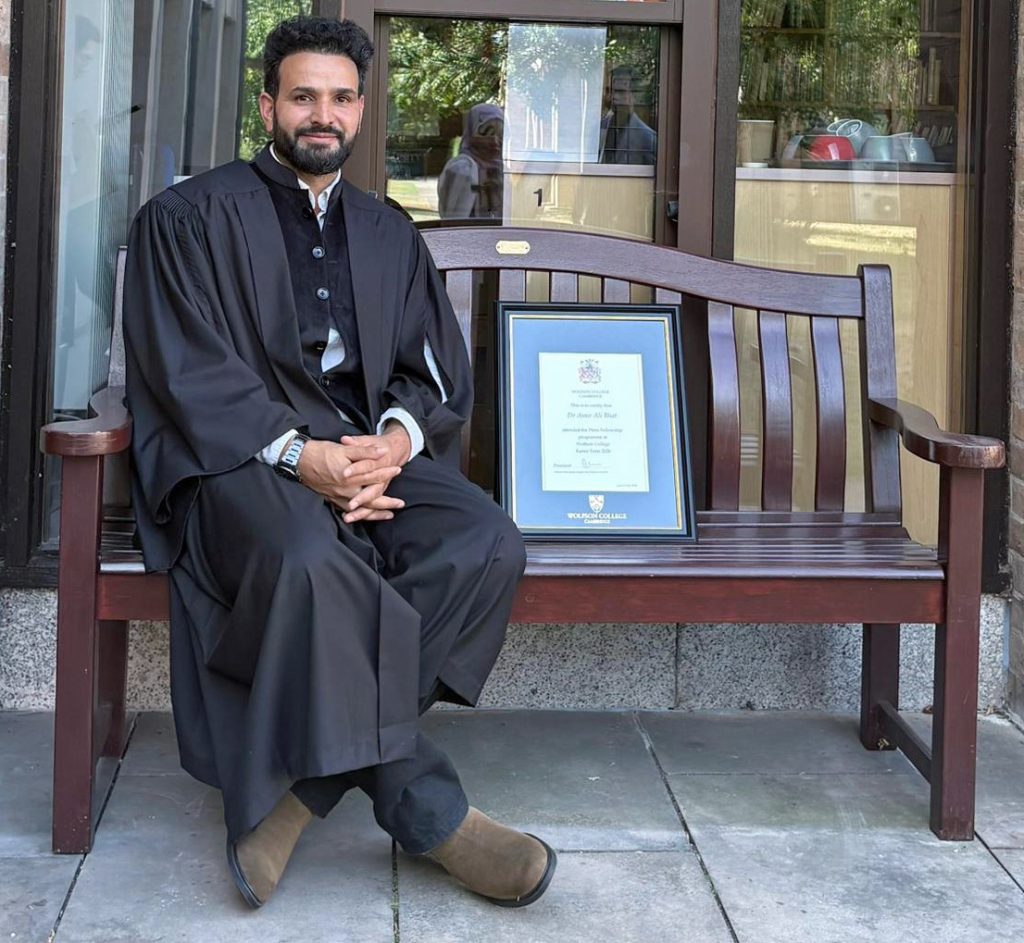
By AMIR ALI BHAT, pictured, journalist and researcher based in Kashmir, and winner of the 2026 Derek Ingram Press Fellowship, sponsored by the CJA
When I received an email informing me that I had been selected as a Derek Ingram Press Fellow for 2026, hosted by Wolfson College, University of Cambridge, in partnership with the Commonwealth Journalists Association, my joy knew no bounds. As a journalist and researcher from Kashmir, a region shaped by prolonged conflict and restrictions, I had been striving for this opportunity for many years.
I arrived in Cambridge on 2 May 2026 carrying two things: hope and nervousness. Since it was my first visit to the United Kingdom, the nervousness was understandable. The culture, the academic environment, and even everyday social interactions were new to me. Yet within days, the warmth and hospitality of Wolfson College made me feel at home. At the same time, I arrived with hope. The years leading up to the fellowship had been among the most challenging of my life, both personally and professionally.
My time at Wolfson proved transformative. The college provided me with the space, support, and intellectual environment that enabled me to restore my personal wellbeing, regain my confidence, and rediscover my capacity to think critically, learn, and grow as both a journalist and a researcher. It also offered access to outstanding academic resources and an intellectual atmosphere that would otherwise be difficult for a journalist and researcher like me to find back home in Kashmir.
Broader responsibilities of journalism
One of the most memorable moments of my fellowship was my first meeting with my supervisor, Professor John Naughton. Instead of meeting in a formal office setting, John invited the other Press Fellows and me to his home in Madingley, a village on the outskirts of Cambridge, for dinner. John and his partner, Fiona, welcomed us with warmth and kindness before taking us for a walk through the beautiful village.
Over the course of the fellowship, John’s humility, guidance, and encouragement opened up new ways of seeing not only my own work, but also the broader responsibilities of journalism itself. My project investigated whether emerging water-related health risks in Kashmir are linked to the rapid melting of glaciers and contaminated rivers. Alongside encouraging me to delve deeper into my project and pursue genuine investigative approaches, John connected me with experts whose knowledge greatly enriched my understanding of the subject. More importantly, John demonstrated what good mentorship looks like. If I ever have the opportunity to supervise students or young journalists, I will draw inspiration from the example he set.
The Friday seminar series became one of the highlights of the fellowship. Every week, fellows gathered to discuss a wide range of topics, including artificial intelligence, freedom of expression, and scientific research in Antarctica, among many others. Each presentation by invited experts was followed by lively discussions that enriched my understanding of these important and timely issues.
Changing media landscape
Moreover, we visited some of the United Kingdom’s leading media organisations, including the BBC, ITV, Channel 4, and The Observer. These visits provided invaluable insights into newsroom operations, editorial decision making, and the future of journalism.
This fellowship was also unique in that it marked a period of transition. As John retired from his role as Director of the Press Fellowship Programme and Dr Richard Danbury prepared to succeed him, our cohort had the unique opportunity to learn from both. Richard regularly joined Friday seminars, discussions, and visits to media organisations, and his insights on journalism, freedom of expression, and the changing media landscape were immensely valuable. Listening to both the outgoing and incoming directors offered us a rare opportunity to benefit from two experienced professionals.
Furthermore, Michelle Searle, the College Registrar, made my stay more comfortable. She was among the first people I met upon arriving at Wolfson. She gave me a tour of the college, helped me settle into my new environment, and, throughout the fellowship, remained incredibly supportive. Whether the issue was simple or complicated, Michelle was always ready to help with patience, kindness, and professionalism. Equally memorable were the interesting conversations with the College Vice President, Dr Kevin Greenbank, and the generous advice and support of Prajakti Kalra, Manager of the Wolfson College Research Networks.
The fellowship also provided opportunities to engage with scholars, students, and professionals from diverse cultural and national backgrounds. These interactions gave me a chance to learn about different societies, political systems, academic traditions, and cultural practices. I particularly enjoyed the exchanges I had with my colleagues from Malaysia, with whom I frequently discussed our respective cultures, political realities, social challenges, and professional experiences. These conversations broadened my perspective and reminded me of the value of international dialogue and understanding.
Professional development
I also had the privilege of giving a talk on my research, jointly organised by the Centre of South Asian Studies and the Wolfson College Research Networks. The feedback and discussions that followed strengthened my confidence and helped refine my ideas.
By the end of the fellowship, I realised that its impact was far more than another achievement on my CV. It broadened the scope of my work, renewed my confidence, and deepened my commitment to journalism. The lessons I learned at Wolfson will continue to shape my work for years to come.
On the Sunday of our final weekend as Press Fellows, John and Fiona once again welcomed us to their home, this time for afternoon tea. Afterwards, we took another stroll through the same peaceful village of Madingley. As we walked along the familiar paths, one of my colleagues, Muhammad from Malaysia, smiled and remarked that it felt as though we had walked the very same route only yesterday. We all laughed, because that was exactly how we felt. The ten weeks had passed so quickly that it seemed as if we had only just arrived at Wolfson.
It was a reflection of how deeply we had come to enjoy our time there and how difficult it was to accept that it was already coming to an end. Returning to the same village where my fellowship had begun brought everything full circle.
I realised how much had changed during those weeks. I arrived as someone searching for confidence and renewal. I left carrying everything I had hoped to find: knowledge, learning, personal growth, professional development, friendships, and memories. The memories I take from Cambridge are not merely recollections of places and events. They are memories of conversations, kindness, mentorship, and belonging, which have become an indelible part of my life and will remain with me forever.
For that, I will always remain grateful to Wolfson College and CJA.
- The Ingram Press Fellowship is run by the Wolfson Press Fellowship Programme in conjunction with the CJA. It honours the memory of Derek Ingram, the distinguished journalist who did much to improve media coverage and public understanding of the Commonwealth throughout his long career. It’s an opportunity for journalists in mid-career to research a project of their own choosing under light academic supervision.
