
Despite mounting pressure at home and abroad, the many journalists picked up by the authorities in Bangladesh as long ago as last August remain firmly in detention.
The latest attempt to gain freeedom for two of the more prominent detainees – husband and wife team Farzana Rupa and Shakil Ahmed of the Ekattor TV channel – was thwarted by the Supreme Court, which over-ruled a High Court decision to free them on bail. They have been charged with the murder of a student protestor in Dhaka, a charge they say is fabricated for political reasons.
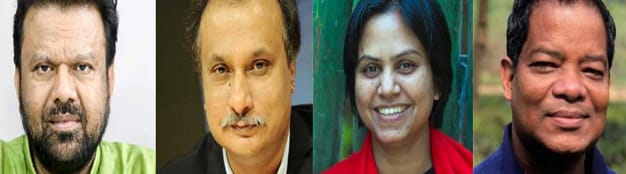
Detained journalists Shyamal Datta, Muzammil Babu, Farzana Rupa and Shakil Ahmed are pictured here:
Sushama Shashi, the daughter of another of the leading detainees CJA vice-president Shyamal Dutta, told the CJA that her family felt empowered by the strength of support for the journalists. She said her father expressed his thanks for for all the campaigning, during a prison visit.
The CJA and Commonwealth Human Rights Initiative have stepped up efforts to have impact through international channels including the UN/UNESCO following the acceptance by Commonwealth leaders of the Media Principles at the recent summit – which calls for practical actions by states to fulfil their obligations to protect journalists and free speech.
A UK legal firm has filed complaints to the UN Working Group on Arbitrary Detention, and also to the UN special rapporteur on freedom of opinion and expression, Irene Khan.
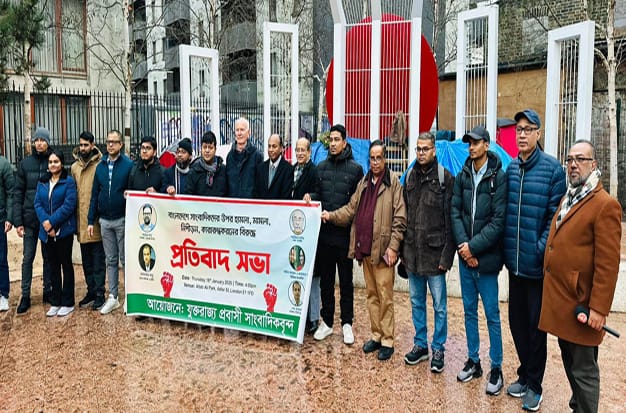
In London, a protest gathering was held by British Bangladeshi journalists demanding the release of detained journalists, pictured above. Addressing the demonstration, CJA executive committee member Richard Bourne recalled that recently, at the Commonwealth heads of government conference, countries including Bangladesh, approved a statement on media freedom and good governance. Despite this, incidents of torture and harassment of journalists continued in that country.
Journalists right now in Bangladesh are in fear of losing their jobs, being arrested or worse, being a victim of mob justice …
It’s estimated that charges have been laid against well over 100 journalists in the political crisis following the overthrow of Sheikh Hasina’s government in August 2024. Media and civil rights campaigners have called on the interim administration of Mohammad Yunus to protect journalists, who they say face bogus charges, meant to intimidate.
- We say Drop these trumped-up charges
- Respect media freedom – our urgent message to the new regime in Bangladesh
- From self-censorship to documenting repression – media’s role in the toppling of Sheikh Hasina
Ms Shashi said a “massive injustice” was being done to journalists in Bangladesh.
“Those imprisoned are forced to sleep on the floor, not provided with medical assistance when needed or food according to their health requirements. My mother had to navigate through multiple obstacles for a period of two months only to be able to pass the CPAP machine to my father in jail who suffers from sleep apnea, by which time he was hospitalised in jail twice. Mojammel Babu, who is a cancer patient, has not been allowed a single treatment for his disease.
Exhausted
“When my father got arrested, we had faith in the High Court of Bangladesh. We had proceeded with the murder case that was filed against my father through lower courts, with hopes that ultimately, we will get justice in the High Court. It was only on the 5th of January that my mother and I decided that we will take Dad’s case to the High Court. Surprisingly, on the 6th of January, my father, along with seven other journalists were slapped with an attempted murder case.
“Apparently, these journalists, along with 82 others, attempted to murder a single person in police custody back in 2013. My father now has 2 cases – the murder case he was arrested on and this latest attempted murder case.
“Journalists right now in Bangladesh are in fear of losing their jobs, being arrested or worse, being a victim of mob justice. This has made it extremely perilous for local press organisations to advocate for their own colleagues who are in jail, and hundreds of others on whom random murder and attempt to murder cases have been brought.
“I have exhausted myself to the point of physical illness while advocating for my father. I have decided to deal with his latest attempt to murder case, but I will need all of your help again. Any kind of verbal and or written advocacy will help me and the families of the journalists in prison tremendously. We genuinely feel as though we are attempting to move mountains.”
Bangladesh’s Editors’ Council has condemned the action against journalists, saying it undermines the interim government’s commitment to protect an independent media.
The detentions come against a background of more violence directed at media outlets in Bangladesh – several journalists have been targetted and killed in recent months.
In more international reaction, the Committee to Protect Journalists expressed alarm at the “apparently baseless criminal cases lodged against Bangladeshi journalists in retaliation for their work, which is seen as supportive of the recently ousted government”. A spokesman called on the government to safeguard the ability of all journalists to report without fear of reprisal.
Promise to protect
The French-based RSF deplored recent developments in a message to Mohammad Yunus, saying the government must keep its promise to protect journalists, in line with its duty to ensure their right to a fair trial. It said it must ensure that all journalists can produce information, work safely and with complete independence, without fear of legal prosecution.
The International Federation of Journalists, IFJ, said the Bangladeshi media must be free to report without fear of retaliation, and a plurality of voices must be encouraged through the Interim Government’s time in power.
The Bangladesh Manobadhikar Sangbadik Forum, an affiliate of the IFJ, said the actions by the authorities meant that journalists were being criminalised and this could not be allowed to continue.
The Observatory of Killed Journalists, published by UNESCO, reports that five journalists lost their lives in Bangladesh last year up until August 4, and that 33 have been killed in the last 30 years. And the World Press Freedom Index reports a significant drop in the country’s standing – it now ranks 165th out of 180 countries surveyed.
