
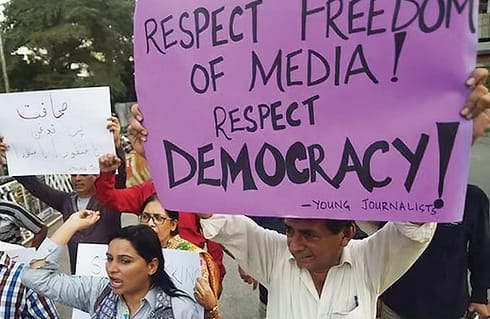

This article was submitted by the By Rural Media Network Pakistan, an independent body set up to support the struggle of the many journalists in Pakistan, away from the big cities, who day to day come under harassment from many sides.
Pakistan, a country of more than 250 million people, has one of South Asia’s most dynamic media landscapes. Hundreds of newspapers, television channels, radio stations and digital platforms operate across the country. Yet behind this diversity lies a troubling reality: journalism remains an increasingly hazardous profession, particularly for those working outside the country’s major metropolitan centres.
Violence, intimidation, arbitrary arrests, legal harassment, economic insecurity and digital abuse continue to threaten media freedom. While attacks on prominent journalists in Islamabad, Lahore, Karachi, Peshawar and Quetta often receive widespread national and international attention, journalists serving Pakistan’s rural districts and regional media organisations frequently face these dangers in relative isolation.
According to monitoring conducted by Rural Media Network Pakistan (RMNP), 159 journalists have been killed in the line of duty during the past 25 years. A substantial number of these journalists belonged to regional newspapers, local television channels and small-town media organisations, where security arrangements, legal assistance and institutional support are often minimal.
Approximately 65 percent of Pakistan’s population lives in rural areas, yet the country’s media industry remains overwhelmingly urban-centred. Editorial decision-making, advertising revenue, media ownership and professional support mechanisms are concentrated in major cities. Consequently, the concerns of rural communities – and the journalists who report on them – often receive insufficient attention.
Regional journalists play a critical role in informing the public about issues that directly affect millions of Pakistanis. They report on agriculture, irrigation, water scarcity, education, healthcare, local governance, climate change, environmental degradation, land disputes, corruption, organised crime and human rights. Their reporting provides an essential bridge between local communities and national policymakers.
Despite this vital contribution, the regional press faces severe pressures. Many regional newspapers operate with extremely limited financial resources. Local correspondents are often poorly paid, work without formal employment contracts and receive little or no insurance, legal protection or safety training. Some journalists must finance their own travel and communication costs while covering stories in high-risk environments.
” … journalists frequently encounter attempts by influential political figures, feudal interests, criminal networks and local administrations to suppress reporting through threats, intimidation, withdrawal of advertising.”
Political and economic pressures are equally significant. Regional journalists frequently encounter attempts by influential political figures, feudal interests, criminal networks and local administrations to suppress reporting through threats, intimidation, withdrawal of advertising, fabricated legal cases or arbitrary detention. Because these journalists often work in smaller communities, they are more exposed and have fewer opportunities to relocate or seek institutional protection.
The disparity in attention becomes especially apparent when journalists are attacked. Incidents involving journalists employed by major national media organisations usually trigger immediate statements from press freedom groups and extensive media coverage. Such solidarity is important and necessary.
However, attacks on journalists working in rural districts and small towns frequently receive limited national attention. Many cases remain confined to local news coverage despite involving serious violations of press freedom. Families of murdered journalists often struggle for years to obtain justice, while perpetrators continue to benefit from a persistent culture of impunity.
Since its establishment in 2004, the Rural Media Network Pakistan has consistently advocated for the safety, rights and professional development of journalists, with particular emphasis on strengthening the regional and rural press. RMNP believes that press freedom cannot be fully protected if journalists working outside major cities remain overlooked.
Protecting journalism in Pakistan requires a more inclusive approach. Safety programmes, legal assistance, emergency response mechanisms, professional training and advocacy initiatives must reach regional media organisations as effectively as they reach large national news outlets. Every attack on a journalist – whether in a provincial capital, a district headquarters or a remote village – should receive the same urgency, the same public attention and the same commitment to accountability.
A free press is measured not only by the strength of its national media but also by the safety and independence of its regional journalists. Protecting Pakistan’s rural and regional press means protecting the voices of millions of citizens whose stories might otherwise never be heard.
