

.
1/3/2026
Pakistan’s government has stepped up the use of in absentia convictions and arrest warrants against Pakistani journalists living overseas, the Committee to Protect Journalists has reported.
It says the move highlights an escalating crackdown by Prime Minister Shehbaz Sharif’s government on critical reporting and commentary that extends beyond domestic borders.
In early January, four foreign-based Pakistani journalists and commentators were convicted on the same day in connection with coverage of violent protests that hit Pakistan in May 2023, following the arrest of former Prime Minister Imran Khan in a corruption case. The government accuses Khan, who is in prison on several charges that he says are politically motivated, and his allies of inciting the protests, during which demonstrators attacked military and government buildings.
Authorities also issued an arrest warrant for an exiled journalist in early December, alleging he had spread propaganda about Pakistan’s army.
On December 1, Interior Minister Mohsin Naqvi pledged a massive crackdown on social media users, YouTubers, and journalists spreading “fake news”, and warned those living overseas that, “We will soon bring you back, and you will be answerable.”
“Repression on a global scale”
“Pakistan’s repression of journalists has now reached a global scale, leaving journalists unsafe and unable to report freely or even express their views on events back home,” said CPJ’s Asia-Pacific Director Beh Lih Yi. “We call on the Pakistani government and military to cease targeting journalists and their families, and restore press freedom inside the country.”
CPJ has documented the following cases in which the Pakistani government has sought to criminalise journalists living abroad, based on interviews with affected journalists, court files reviewed by CPJ, and news reports.
In absentia convictions:
On January 2, an anti-terrorism court in Islamabad sentenced four journalists and commentators in absentia each to two life sentences, plus 35 years, and substantial fines for allegedly inciting violence during the 2023 protests and spreading hatred against state institutions.
The court found the journalists guilty of anti-state offences under Pakistan’s Penal Code and terrorism-related offences under the Anti-Terrorism Act, 1997.
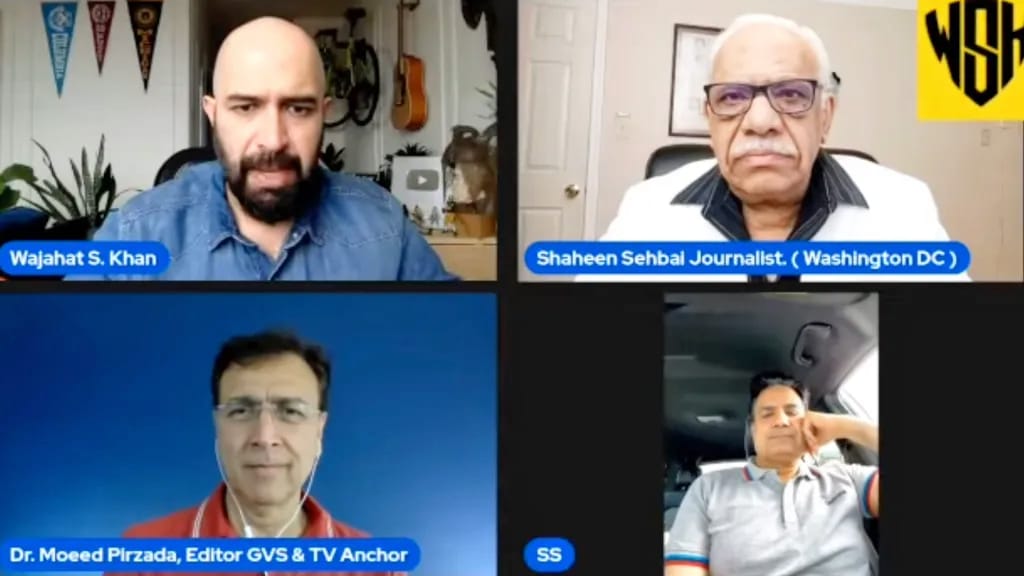
The four are: Sabir Shakir, a former anchor for ARY News and UK-based journalist who runs a YouTube channel with 2.8 million subscribers; Shaheen Sehbai, a US-based freelance journalist and former editor of English-language newspaper The News International; Wajahat Saeed Khan, a US-based journalist who reports on Pakistan and South Asia primarily through his YouTube channel, which has 544,000 subscribers; Moeed Pirzada, a British-Pakistani journalist, popular YouTuber, and US-based editor for news website Global Village Space.
In a joint statement issued on January 6, the four journalists and three co-accused said they did not recognise the court verdicts. They stated that at no stage were they formally notified of charges, served with summonses or indictments, informed of hearing dates or venues, provided access to evidence, or given the opportunity to appear, respond, or appoint lawyers.
The in absentia convictions are incompatible with Pakistan’s constitution and commitments made under the International Covenant on Civil and Political Rights, the group said.
Mr Sehbai, who has 1.8 million followers on X, told the CPJ he was unaware of the court ruling until it was reported by the media. He said the verdict was intended to intimidate journalists and he was fearful of threats and efforts to extradite him. His Pakistani passport, national identity card, and official documents have been canceled.
Mr Shakir said that his and his wife’s national identity documents and bank accounts had been frozen. He said that individuals linked to the Pakistani army contacted him at least three times before the court ruling offering to drop the charges if he stopped reporting critically on the government and military.
Declared a fugitive
In early December, an Islamabad court issued an arrest warrant for exiled Pakistani journalist Ahmad Noorani for allegedly spreading propaganda against the army on social media, according to multiple news reports.
Noorani, a co-founder of investigative news site FactFocus, told the CPJ he was unaware when the case was registered against him or its details. He said the arrest warrant and his status as an “absconder” effectively barred him from traveling to countries with close ties to Pakistan because he could face immediate detention.
Mr Noorani is facing multiple other cases in Pakistan, which he believes are linked to his investigative reporting on alleged interference by Pakistan’s army chief, Field Marshal Asim Munir, in civilian institutions, and corruption by senior army leaders.
He said his two brothers, who were abducted from his Islamabad home in March 2025 and disappeared for more than a month, continue to face harassment. His family has been placed on a travel blacklist, their bank accounts frozen, and both brothers have lost their jobs.
Interior Minister Naqvi and National Cyber Crime Investigation Agency Director Syed Khurram Ali did not respond to the CPJ’s text messages or emails seeking comment.
According to the International Federation of Journalists’ global assessment, three media workers were killed in Pakistan last year. The media rights organisation Reporters Without Borders has said that Pakistan’s position in its global press freedom world ranking has dropped to 158th place.
A report from The Council of Pakistan Newspaper Editors says that despite complete control and censorship over Pakistani media throughout 2025, journalists continued to face murders, arrests, treason cases, forced removals from broadcast, bank account closures, placement on the Exit Control List, and withdrawal of advertising revenue from media organisations.
