
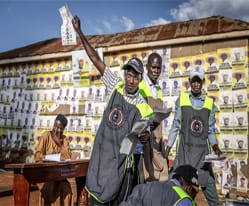
The presidential election in Uganda in January took place in a climate of total internet blackout,
defying the global order of digitalized media space, writes ALICE DRITO.
There was a heavy military presence, excessive use of force by the police and
security operatives against journalists and arrests of human rights
defenders, political opposition leaders and their supporters.
Journalists on the campaign trail, especially those covering the
opposition presidential candidates, were subjected to harassment,
physical assaults by security operatives, seen helplessly struggling
in self-defence, while protecting their cameras. https://www.youtube.com/watch?v=XvlxuWL7SC8
Such actions were witnessed by Election Observers.
One was prompted to ask whether cameras looked like
guns in the eyes of the police or security agents, as if they could not
differentiate between the two.
The memory of continued police brutality against journalists as
depicted in media reports may take a long time to fade. Journalists
will live to rewrite the history of Uganda’s election cycles, recounting
their own experiences of the 2026 elections.
Media NGOs shut down
The authorities suspended some radio stations and banned media
houses critical of the state from covering presidential events. Two
media non-governmental organizations, the African Centre
for Media Excellence and the Human Rights Network for
Journalists Uganda were closed in a crackdown on civil
society organisations.
Uganda’s elections displayed new standards of democratic
behaviour, media freedom and what can happen when the
authorities do not invest in the protection and safety of journalists.
In Africa, election-related internet shutdowns by the
authorities are becoming a new culture. Civil society groups raised the
alarm about the internet shutdown during elections, pointing out that
it compromised internationally-accepted elections standards and
principles, threatened media freedom and violated human rights to
access information.
Media experts say journalism is no longer doing the job as usual in
the new normal of digital blackouts during chaotic elections. In its
absence, there is a breeding space for rumour-mongering,
misinformation and electoral malpractice.
