
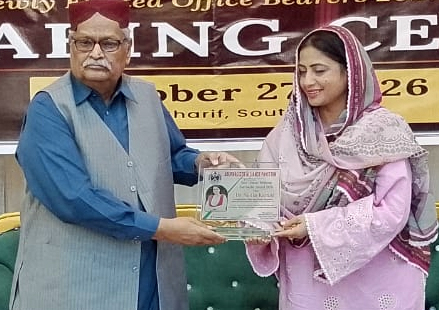
Picture shows Dr Sadia Kamal, President of the Federal Union of Journalists Workers, receiving an award for Best Female Working Journalist, from the Journalists Alliance founder Ehsan Ahmed Sehar.
4/11/26
A further series of intensive training programmes has been held in South Punjab, organised by the Rural Media Network Pakistan and the Journalists Alliance Pakistan. The courses bring together rural and town press clubs and journalists’ organisations to strengthen professional co-operation, expand access to training and give greater visibility to the concerns of journalists working outside the country’s major media centres.
The International Press Institute collaborated in an online training workshop in Ahmedpur East, entitled “How Newsrooms Can Build an Effective Response Against Online Harassment.” The specialised session was delivered remotely from Vienna by Javier Luque, head of IPI’s Digital Media and Online Safety.
The training examined practical newsroom procedures to prevent and respond to online abuse, assess risks, support journalists targeted by digital attacks and maintain professional standards. The session covered four areas: effective response procedures, preventive safeguards, recovery and support mechanisms, and adaptation of newsroom protocols to the resources and needs of individual media organisations.
There was a one-day capacity-building workshop at Uch Sharif entitled “Strengthening Local Journalism: Skills, Ethics & Technology.” It brought together 166 male and female journalists from the towns and districts of South Punjab.
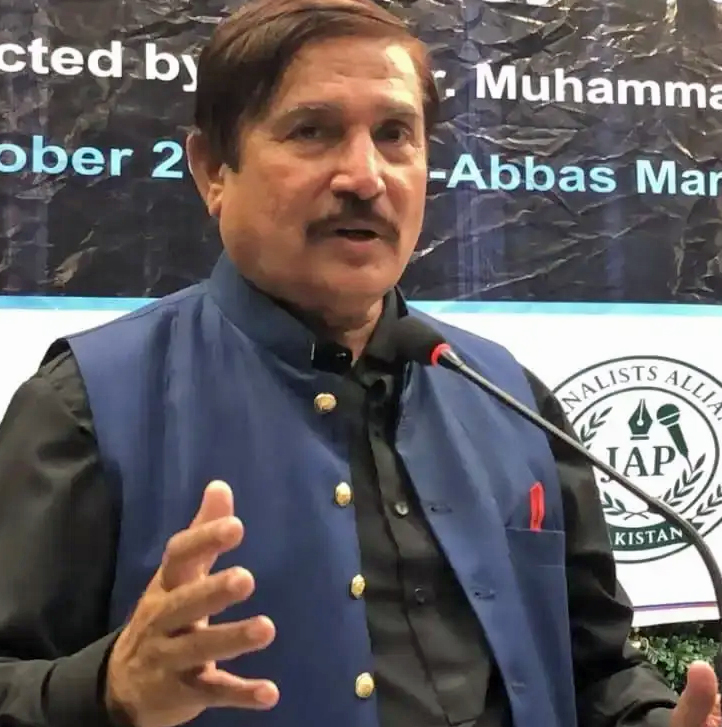
Prof Muhammad Shehzad Rana, pictured, former Chairman of the Department of Media and Communication Studies and Director of Community Broadcasting at The Islamia University of Bahawalpur, led the training sessions. He addressed digital storytelling, the core values and treatment of news in a rapidly changing digital environment, and the importance of producing journalism that is timely, impactful and truthful while also being visual, concise and shareable.
In a third event, more than 200 journalists from rural areas and towns of South Punjab attended an oath-taking ceremony in Uch Sharif. Dr Sadia Kamal, President of the Pakistan Federal Union of Journalists, chief guest, spoke of the need to strengthen media organisations in underserved areas.
She emphasised press freedom and journalists’ safety as a national priority, and called for fair implementation of laws, effective action against harassment, independent protection mechanisms, timely payment of salaries, safe working environments and access to modern journalism training.
Organisers of the training events said they were a practical contribution to strengthening journalism beyond major urban centres, and they looked forward to continued engagement with the IPI and other international press freedom organisations to expand opportunities for rural journalists, improve newsroom safety and promote professional standards.
